
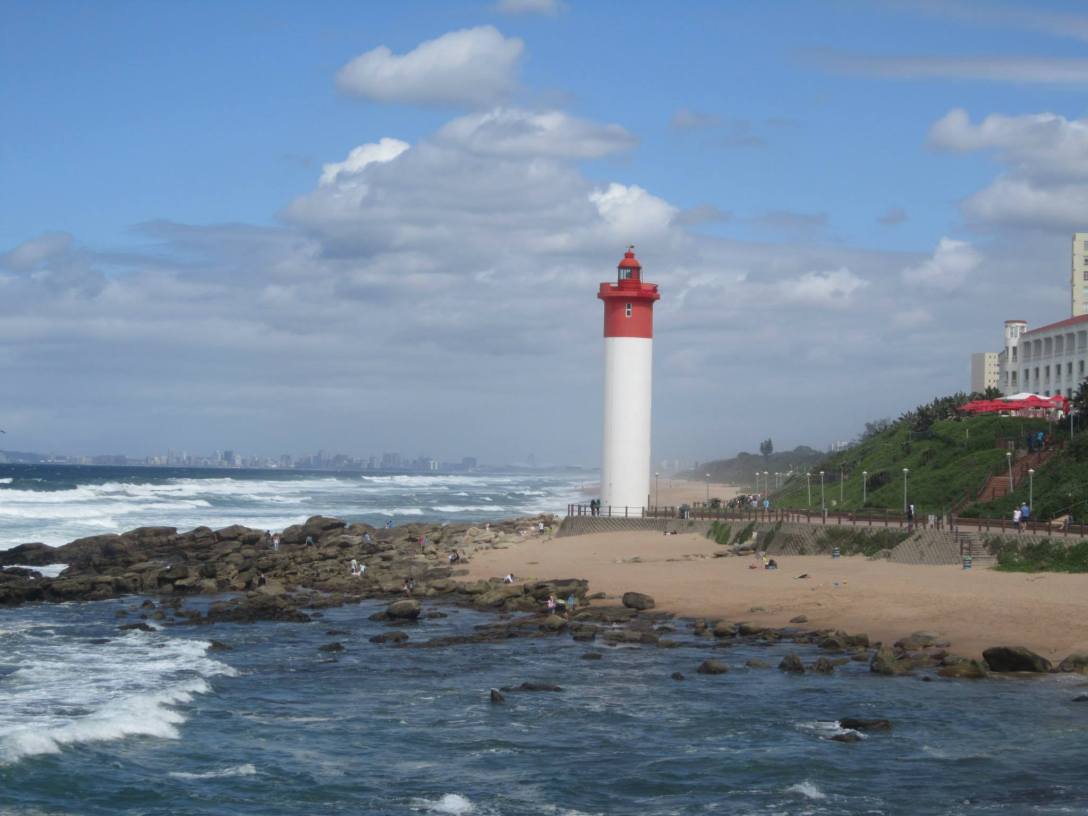
THE LIGHTHOUSE GOT VETOED
Apparently, a lighthouse is too woo for a serious coaching website.
I had a photo I loved. I took it myself — a lighthouse on the edge of a beach in South Africa, waves crashing against it. Strong. Solid. Pristine. Doing exactly what a lighthouse does — standing its ground while everything around it moves.
Corporate coaching has a look. My lighthouse didn’t fit it. I respect the logic.
I just don’t have to agree with it.
So I started thinking about what we replace lighthouses with.
A boardroom shot, maybe. A glass table, empty chairs, very important. Or the classic: someone standing with their arms folded looking serious and professional. Or — my personal favourite — a quote on a board. You know the ones. They’re everywhere on LinkedIn. Right next to the ads pretending to be insights.
Very credible. Very substantive. Extremely authentic.
I roll my eyes every time.
What Performing Seriousness Actually Costs
There is a version of professionalism that is entirely performance. The neutral face held in place during a difficult meeting. The steady voice when the numbers are bad. The composed response when someone pushes — measured, considered, giving nothing away.
We learn this early. In corporate environments it gets rewarded. You become known as the person who never rattles. The one who handles it. The one others come to when things get hard because you will not fall apart.
What nobody mentions is what that performance costs.
Performed composure is held in place by effort. Constant, invisible effort. Are my shoulders relaxed? Is my voice even? Does this look like I have it together? It runs underneath every meeting, every difficult conversation, every high-stakes decision. And it compounds. The longer you hold it, the more it takes to maintain — and the less access you have to the thing underneath it. Your actual judgment. Your actual clarity. The read on a situation that used to come quickly and now feels slower than it should.
I see this in the people I work with. The ones who have become so skilled at looking unrattled that they have lost touch with what unrattled actually feels like. The ones who leave the high-pressure meeting and immediately go somewhere private to decompress — not because they are weak, but because the performance took everything they had.
I see it in parents who hold it together all day and then lose it over something small at 6pm, surprised by their own reaction.
I see it in professionals who project certainty and quietly wonder why the work feels hollow.
I’ve seen it in myself.
The pattern is the same everywhere. We got so good at the performance that we forgot it was one.
What the Lighthouse Actually Does
A lighthouse does not perform.
That thing I photographed in South Africa had waves throwing themselves at it and it did not move. It did not reconsider its position. It did not post about resilience. It just stayed lit.
It doesn’t chase the ship. Doesn’t follow up. Doesn’t micromanage the route. Doesn’t radio ahead to make sure it was seen. Doesn’t reorganize itself to look more impressive from certain angles. It doesn’t justify its existence or explain its value or pivot its strategy when ships stop coming. It picks a spot, stays there, and lights up.
And somehow — without a productivity system, without a personal brand strategy, without performing its relevance for anyone — it guides huge vessels home.
That is not passivity. That is something much harder than activity. It is the discipline of staying in one place, remaining lit, and trusting that the light is enough.
Most high performers have never tried that. Staying still feels like falling behind. Being present feels like not doing enough. The instinct is always to move, to manage, to intervene — because effort is the only currency that has ever felt safe.
The lighthouse doesn’t share that instinct. And that is exactly why it works.
The People I Think About
I think about the people I work with who are running on empty trying to manage every outcome. The partner who reviewed everything twice because trusting his own judgment felt too risky. The parent who couldn’t stop correcting because stillness felt like neglect. The executive who had become so good at pushing through that she had forgotten what it felt like to just know something clearly.
One of those people was me. I got so good at pushing through that I forgot what it felt like to do something I truly loved — instead of measuring everything against what it said about my performance.
None of us needed more effort.
We needed to become the lighthouse. Steady. Unmoving. The chaos around it never changed what it did.
What Becoming the Lighthouse Actually Looks Like
It looks like calm in the middle of chaos. Not perfect. Not untouched by what is happening. Just solid. The person in the room who is not adding to the noise — whose presence alone tells everyone else that this is manageable. You have seen that person. You remember how it felt to be around them.
That is the lighthouse.
It does not look dramatic. That is the first thing to understand.
It looks like the leader who pauses before responding instead of filling the silence immediately. Who asks one clear question instead of offering three solutions. Who stays in the room with discomfort long enough for something true to surface — rather than moving to action because action feels safer than stillness.
It looks like the parent who takes a breath before reacting. Who lets the moment land before deciding what it means. Who knows that their regulated state is doing more for the child in front of them than any instruction ever could.
It looks like the professional who stops performing certainty and starts operating from actual clarity — which is quieter, slower, and considerably more useful under pressure.
The people in the room can feel the difference even when they cannot name it. A regulated presence does not announce itself. It does not demand attention or perform authority. It simply holds — and in holding, it creates the conditions for everyone else to think more clearly.
That is what a lighthouse does.
It does not guide ships home by being impressive. It does so by being unmistakably, reliably there.
The Irony Worth Naming
We spend enormous energy performing seriousness. The corporate look. The folded arms. The boardroom aesthetic. The carefully managed impression of someone who has everything under control.
And in doing so, we exhaust the very thing that makes us effective.
The lighthouse got vetoed from my website.
But I kept the idea.
The physiology behind why performing composure costs more than it should — and what actually helps the nervous system find its way back — is something I explore in depth in Holistic Vagus Nerve Reset..
I write a weekly newsletter on performance, pressure, and the internal dynamics most people don’t talk about. The Clarity Brief goes out every Wednesday. Join here.
Discover more from Reflections
Subscribe to get the latest posts sent to your email.

 Reflections