
It was a Tuesday afternoon.
Nothing dramatic had happened. No crisis, no conflict, no reason you could point to. But somewhere around 3pm you hit a wall. Your patience ran out mid-sentence. You snapped at someone — a colleague, a partner, maybe your child — and then felt the familiar wave of frustration at yourself on top of everything else.
You assumed it was just a bad day.
It wasn’t a bad day. It was a nervous system that had been running without a brake for hours — and finally reached its limit.
Understanding what happened in your body during that moment is not just interesting information. It changes everything about how you respond to stress, make decisions, and recover.
The Brake Pedal You Did Not Know You Had
Your nervous system has two primary states. The first is activation — the fight, flight, or freeze response your body uses when it senses a threat. Heart rate rises, breath shortens, attention narrows, and your body prepares to respond to danger.
The second state is regulation — the return to safety, calm, and clear thinking. This is where your body repairs itself, processes information fully, and makes its best decisions.
The structure responsible for moving you from activation back to regulation is the vagus nerve.
The vagus nerve is the longest cranial nerve in the body. It runs from the brainstem down through the throat, heart, lungs, and digestive system. It is the main communication highway between your brain and your body, and it plays a central role in your body’s ability to self-regulate after stress.
When the vagus nerve is functioning well — when it has what researchers call good vagal tone — your nervous system moves through activation and returns to calm relatively quickly. You get activated. You recover. The cycle completes.
When vagal tone is low, the return does not happen cleanly. The activation lingers. Stress accumulates. And by 3pm on a Tuesday, the system is already at its limit before the next thing arrives.
Why Most People Are Running Without Brakes
The modern environment is not designed for regulation. It is designed for input.
From the moment most people wake up, the nervous system is receiving signals: notifications, news, decisions, expectations, conversations, noise. Each one requires a response from the body, even when the response is subtle.
The problem is not that stressful things happen. The problem is that there is no return. No completion. No moment where the system is allowed to come back down before the next input arrives.
Over time, the baseline shifts. What used to feel stressful becomes the new normal. The body adapts by staying in a low-level state of activation — not full threat response, but not regulated calm either. Always slightly braced. Always slightly on.
This is the state most high-functioning people live in. They call it drive, or ambition, or being productive. And it works — until it doesn’t.
The wall you hit at 3pm is not weakness. It is physics. A system that never fully resets eventually runs out of runway.
What the Research Tells Us
The vagus nerve has been studied extensively in the context of stress, emotional regulation, and decision-making.
Research consistently shows that higher vagal tone is associated with greater emotional resilience, better recovery from stress, improved focus, and more regulated interpersonal behavior. Lower vagal tone is associated with increased anxiety, impulsivity, difficulty recovering from conflict, and poorer decision-making under pressure.
What this means practically: the quality of your nervous system regulation is not just about how you feel. It directly influences how you think, how you lead, and how you show up in the moments that matter most.
The other significant finding is that vagal tone is not fixed. It responds to practice. Specific inputs — breath patterns, movement, sound, social connection — signal safety to the nervous system and activate the vagus nerve. With consistent practice, the baseline shifts. The return to calm becomes faster. The window before the wall extends.
The Reset Is Simpler Than You Think
Most people assume that regulating the nervous system requires significant time, silence, or a particular setting. It does not.
The vagus nerve responds to breath. Specifically, it responds to the exhale.
When the exhale is longer than the inhale, it signals to the body that it is safe to shift out of activation. The heart rate slows. The chest softens. The loop begins to close.
This is not a breathing technique you need to learn in a workshop. Your body already knows how to do it. The practice is simply learning to use it deliberately — not only in crisis, but as a regular pattern throughout the day.
A lengthened exhale before a difficult conversation. A moment of stillness between tasks. A single breath of completion before you move from work to home.
Each one is a small act of regulation. And small acts, repeated consistently, change the baseline.
The Book — And What Comes With It
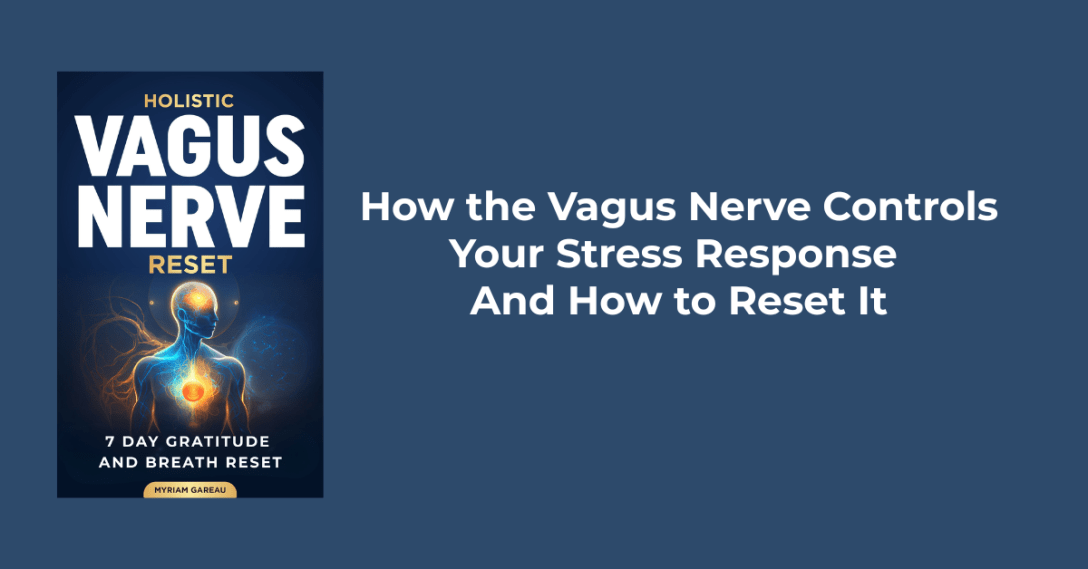
Holistic Vagus Nerve Reset was written to give you a complete understanding of how your nervous system works — and a practical system for working with it rather than against it.
It covers the science of the vagus nerve in plain language, the patterns that dysregulate the nervous system over time, and the specific practices that build vagal tone and improve your capacity to regulate under pressure.
If you want to start experiencing this before you read the full book, I created a free companion resource: the 7-Day Gratitude and Breath Reset.
It is a daily practice journal that takes 5 to 10 minutes per day. Each day introduces one breathing technique that directly activates the vagus nerve — including the Anchor Breath, the Ocean Breath, the Box Breath, and the Extended Exhale — paired with a structured gratitude practice that supports nervous system regulation through a different pathway.
Gratitude and breath together are not a casual wellness combination. Research shows that gratitude practice shifts baseline neural activity away from threat-detection and toward safety. Paired with specific breath patterns, the two practices reinforce each other in ways that produce measurable changes in how your nervous system responds to stress.
Seven days. Five to ten minutes per day. One breathing practice and one gratitude reflection at a time.
You do not need to overhaul your life to begin. You need one deliberate moment each day, and a nervous system that is finally given permission to return to calm.
Download the free 7-Day Gratitude and Breath Reset here.
Holistic Vagus Nerve Reset is available on Amazon – click here.
Myriam Gareau is a performance coach, meditation teacher, and former Risk Advisory professional at KPMG. Her work focuses on nervous system regulation and decision clarity for leaders, professionals, and parents under pressure.
Discover more from Reflections
Subscribe to get the latest posts sent to your email.

 Reflections